----(
Everything You Need To Know About Primary Battery Leakage )
----(
Everything You Need To Know About Primary Battery Leakage )
----(
UV Currency Validation )----(
UV Inspection Applications )
----(
A Customer Project - Ethan Straffin's Spinny Hat Four Point Oh! )

All too often, we receive a message from a customer whose expensive flashlight has
been ruined by an inexpensive set of batteries. And in many cases, the manufacturer
will not honor a warranty service request when the cause of flashlight failure is battery
failure. Over the years, we have found that a great number of flashlight users are not
aware that their batteries have limited lifespans, nor that dead batteries can do some
really serious damage, until they learn those lessons the hard way. But most of these
unfortunate events can be very easily prevented.
Primary batteries are electrical storage batteries that cannot be recharged. Today,
rechargeable flashlight systems (and to some extent, the aftermarket rechargeable
batteries intended for use in conventional flashlights) are continuing to gain in popu-
larity. Nonetheless, the vast majority of flashlights in use around the world today are
still powered by disposable primary batteries. The most common types of primary
batteries used in flashlights are carbon / zinc,
alkaline, and lithium. Each type has
specific advantages and disadvantages, but all of them have a limited storage life.
Low-cost carbon/zinc batteries, now most commonly known as "General Purpose" or
"Heavy Duty" batteries, are the oldest "dry battery" technology for flashlights, and they
have been around for many decades (since about 1900). Carbon/zinc batteries are
usually very inexpensive, but they deliver very limited energy capacities, resulting in a
relatively short shelf life (storage time) and operating life (run time). Carbon/zinc units
exhibit typical initial shelf lives of just one to three years, depending on the battery size
and brand quality. The earliest "General Purpose" types used ammonium chloride as
the electrolyte, but later "Heavy Duty" types utilize zinc chloride for better performance.
The more expensive alkaline batteries utilize a more modern technology (popularized
during the 1960's), that can deliver much higher energy capacity in the same sizes as
the older carbon battery types. Alkaline batteries also offer a much longer initial shelf
life, typically three to five years, depending on battery size and quality. Because they
offer longer run time and better storage life, alkaline batteries are usually a more cost
effective solution over time than carbon cells, even though the initial prices are higher.
In recent years, as technologies have improved, many of the well-known brands have
upgraded their rated shelf lives to seven years for the most common consumer sizes.
And with the latest advances in battery seals and chemistries, the premium domestic
brands now guarantee ten-year shelf life for some of the most popular sizes, and with
designs that may resist leakages for up to two years after becoming fully discharged.
The latest non-rechargeable lithium batteries utilize an even newer chemistry, that de-
livers dramatically higher energy capacity than even the very best of alkaline batteries.
The operating lives (run times) of lithium batteries will often be two to six times that of
the same sizes of alkaline batteries, depending upon the drain rate and usage cycling
of the application. And the disposable lithium batteries provide amazing typical initial
shelf lives of ten years (and up to fifteen years for certain types), depending on quality.
Lithium batteries also weigh less and tolerate temperature extremes better than most
other types, but they usually cost much more, and can become hazardous if damaged.
Because of their extraordinary storage lifespans, leakages of disposable lithium bat-
teries are relatively rare, unless they are mishandled or improperly installed. Further-
more, many of the popular lithium battery sizes have an integral vent that can release
any buildup of gas, and these are unlikely to swell or leak even when very old. So the
remainder of this article will address the lower cost carbon and alkaline battery types.
When carbon or alkaline batteries have become discharged, the chemistry of the cells
will degrade and some hydrogen gas will be generated. This out-gassing will result in
increasing pressure within the battery. Eventually, the excess pressure will either rup-
ture the insulating seals at the end of the battery, or bulge and rupture the outer metal
canister, or both. When this happens, an acidic (for carbon cells) or caustic (for alka-
line cells) electrolyte gel will ooze from the battery. In addition, as the battery ages, its
zinc (for carbon cells) or steel (for alkaline cells) outer canister may gradually corrode
or rust, and this can further contribute to leakage failure. Extremely high temperatures,
such as those in the vehicle glove box during the summer, can also cause batteries to
rupture and leak, even when they are relatively new.
The leaking electrolyte can corrode the metal housing and battery contacts of a simple
flashlight, and it can damage or destroy the delicate circuitry of an expensive electronic
flashlight. Furthermore, swelling of the battery canisters can render one or more of the
batteries hopelessly jammed within the flashlight body. One leaking battery can cause
a chain failure, when its leaking goo corrodes the adjacent ones so that they then leak.
A five dollar set of dead batteries can and will destroy a five hundred dollar instrument
if you let them. Countless numbers of otherwise perfectly fine flashlights are discarded
every year due to battery leaks. Only you can prevent the tragedy of death by leakage.
The most important thing to remember is this: dead batteries will eventually leak. And
all batteries will gradually self-discharge. Even if they are not operating a device they
are installed in, and even when they not installed at all but just sitting on a shelf or in a
drawer, they will slowly lose energy capacity over the passage of time. So, no matter
how good the brand name, your batteries will eventually go dead even if you don't use
them, and when they go dead they will eventually leak. These simple facts lead to just
three easy rules, which must be followed without exception to protect your investment
in flashlights and other battery-operated equipment.
Always remove weak batteries immediately -
All weak batteries are subject to very rapid leakage. When the batteries can no longer
effectively power the device, remove them at once and take them to a recycling center.
If the device has several batteries, always replace every one of them at the same time.
Remove batteries when equipment is stored -
Whenever a given device will not be used for any extended period of time (one month
or more), remove and properly store its batteries. In extreme conditions, such as the
car glove box in the summer in hotter climates, install the batteries only when needed.
This may be inconvenient, but a flashlight that has been destroyed by battery leakage
will do you no good whatsoever, and it will probably never become usable ever again.
Properly store and dispose of your batteries -
Store uninstalled batteries in resealable plastic bags or battery carrier boxes, so that
if they leak they will not damage nearby items. Check them every month or so for any
swelling or leakage. Do not throw away weak or aging batteries, and do not just toss
them into a drawer, but instead take them to a nearby battery store or recycling center
for proper disposal. Note that some states and municipalities now mandate recycling
for all consumer battery types. Please help to reduce the environmental impact of the
billions of batteries that expire each year, recycle them as if your future depends on it.
And by the way, never throw batteries into an open fire or incinerator, and never try to
crush or destroy them, as you may, or may not, live long enough thereafter to regret it.
Here are some additional tips, that will help you achieve the longest possible life from
your battery-operated flashlights and equipment (and could save your own life as well).
Match but never mix -
Never mix old and new batteries, or batteries of different chemistries, or even batteries
of different brands, in any one flashlight or instrument, as the result will nearly always be
unsatisfactory. In some cases, mixing battery chemistries (or mixing rechargeable and
disposable types) can cause fire or explosion hazards that may result in injury or death.
Lithium lasts longer -
For the best results in extreme conditions, always use lithium type batteries (if they are
available in the size and voltage you need), because they will tolerate severe heat and
cold better than any other disposable battery type, and they will usually last a lot longer.
In many cases, premium quality lithium batteries outperform alkaline types of the same
size by a factor of four or more, providing dramatically longer run times and shelf lives.
One warning here, note that there are size "C" and size "D" lithium batteries that yield
double the standard voltage of carbon/zinc or alkaline types. Attempting to use these
obscure 3-Volt batteries in place of standard 1.5-Volt cells will almost invariably result
in immediate and catastrophic failure of the flashlight or equipment (although you can,
for example, use four-cell bulbs in a flashlight designed for two alkaline "D" batteries).
So what do you do if some batteries have already leaked and ruined your flashlight or
other device? Some technicians will tell you that you can wet a toothbrush or a cotton
swab with a solution of baking soda, and scrub away the acidic goo and crust from a
leakage caused by carbon / zinc batteries. Or similarly, apply a solution of household
vinegar to scrub away the residues from a leakage caused by alkaline batteries. This
may actually work in some instances, but the cleaning solution could damage the deli-
cate electronics in sophisticated flashlights or items such as radios and tape players.
And while you may be able to open both ends on some flashlights to push out swollen
batteries, some flashlights can only be opened from one end such that you cannot dis-
lodge batteries that have become jammed due to swelling.
Whenever the damage to a device appears to be unrecoverable, your best option may
be to contact the manufacturer for advice. Some flashlight makers will actually provide
warranty coverage in certain instances, although in some cases this will be limited to a
specific set of battery brands. If the flashlight manufacturer declines to provide service
under the terms of the warranty, you may be able to achieve some compensation from
the manufacturer of the batteries if it is a well-known domestic company. Otherwise, it
may be necessary to pay for repairs, or buy a replacement.

In decades past, United States currency bills depended on a number of specialized
features to deter counterfeiting. These included highly intricate images, imprinted in
distinctive dark green and black inks, and heavy-weight currency paper with a unique
texture and consistency. A pair of matching serial numbers, and a detailed Treasury
Department seal, are printed in an alternate color. And imbedded within the paper
there are fine fibers of deep red and blue colors, this feature being one of the most
difficult to falsify because the appearance cannot be duplicated by ordinary printing.
All of these features have been continued into modern versions of US currency bills.
However, it has become necessary to incorporate some additional security features
to protect our currency from unauthorized duplication. In 1996, the Treasury Depart-
ment began producing new bills with a number of very sophisticated improvements,
designed to make counterfeiting virtually impossible for even the most determined
and well-funded criminals. Extremely detailed microprinting, color-shifting ink, fine-
line backgrounds, watermarks, and enlarged life-like portraits are now being used.
And imbedded within the paper of each new bill, there is a special security thread.
The imbedded security thread is believed to be the ultimate defensive weapon in the
war against counterfeiting, because it would be incredibly difficult, and extravagantly
expensive, to duplicate its unique features and characteristics. The printed security
thread, which is laminated into the paper, can be seen by holding the bill in front of a
strong source of white light. But it also glows brightly when illuminated by UltraViolet
(UV) light, and this characteristic lends itself to easy detection of counterfeit currency.
Many credit cards and other legal instruments also now incorporate UV security tags.
We offer a variety of powerful UltraViolet flashlights that can be used for this purpose.
See our Inova X5, Inova X1, and Photon Freedom Micro ultraviolet lights. Also check
out the Petra-Tek Multi Light & Laser Pointer, a versatile instrument that's perfect for
casino staff, auctioneers, antique dealers, flea-market vendors, and concessionaires.
Other recent additions to our UltraViolet product lineup include the hefty and versatile
Streamlight TwinTask 3C flashlight and handsome Streamlight Stylus pocket penlight.
Law enforcement personnel will benefit from the QuiqLite XP-440 ID version, a handy
little shirt-pocket clip-on light with both white and UV LEDs set into an articulated arm.
Please note that exposure to UltraViolet radiation is hazardous to both eyes and skin.
Never look directly into the beam of any UltraViolet light source, and do not shine into
the eyes of people or animals. To ensure safety for repeated or long-term uses, wear
protective safety glasses with polycarbonate lenses, these will block the UV radiation.
------------------------------------------------------------------------------------------------------------------------
The list below describes the appearance of the security threads in
domestic currency bills when they are viewed under ultraviolet light.
Click on a currency value below for an image of the bill and thread.
Information and source images are derived from the United States
Department of the Treasury Bureau of Engraving and Printing site.
$5 - Blue thread to the left of Lincoln's portrait,
imprinted with "USA FIVE" and a flag image.
$10 - Orange thread to the right of Hamilton's portrait,
imprinted with "USA TEN" and a flag image.
$20 - Green thread to the left of Jackson's portrait,
imprinted with "USA TWENTY" and a flag image.
$50 - Yellow thread to the right of Grant's portrait,
imprinted with "USA 50" and a flag image.
$100 -
Pink thread to the left of Franklin's portrait,
imprinted with "USA 100" but no flag image.
Checking for security threads in United States currency bills is one of the most popular
uses for UltraViolet flashlights, but there are dozens of other applications, and the list is
continuing to grow as new uses are devised. Its effectiveness for validation of currency
bills soon led to the addition of imbedded UV security markings in credit cards, bearer
bonds, and other financial instruments and legal documents. But the scope of applica-
tions for UV flashlights in the forensic sciences and industrial inspection processes has
ballooned explosively in just a few short years, and it seems that there is no end in sight.
Not long ago, UV inspection processes had to be achieved either with bulky and fragile
fluorescent lamps, or with dangerously-hot and uncomfortably-heavy HID (high-intensity-
discharge) lamps. But now we have light-weight flashlights with UltraViolet LED's, and
the easy portability and low cost of these new instruments is leading to extremely rapid
development and instantaneous deployment of new fluorescent inspection applications.
In the sections below, you will find descriptions of a number of popular uses for the new
UltraViolet flashlights. Our most popular UV models are the low-cost Inova X1, and the
small-but-powerful Inova X5. You will find handy UV accessories on our web pages for
each model, including protective yellow glasses and invisible-ink fiber-tip marking pens.
Geosciences & Biosciences -
Some of the earliest applications for UltraViolet illumination arose in the studies of both
mineral and organic substances that fluoresce in the presence of UV radiation. Many
substances can be readily identified by the color and intensity of their fluorescence un-
der various wavelengths of UltraViolet. This has led to numerous technical applications
in chemistry, geology, archaeology, biology (micro to macro) and the medical sciences.
Visual & Performance Arts -
During the 1970's, blacklight posters (with UV fluorescing inks printed onto either black
paper or black velvet) became popular cultural (or counter-cultural) art objects, and they
continue to be popular today, along with blacklight tee-shirts and clothing accessories.
These items were followed by kinetic blacklight art forms such as fluorescent waterfalls
and rotary or reciprocating linear motion scultures. Many visual art blacklight presenta-
tions rely on permanently-mounted fluorescent fixtures. But modern performance artists
now often use light-weight UV flashlights that can be easily carried by hand or attached
to clothing and scenery, for dramatic glowing colors in motion against a black backdrop.
Forensic Investigation -
Popular television shows and movies have established a broad awareness of some of
the more common forensic applications for UV flashlights, including the detection of uro-
genital fluids and exotic chemicals, the use of UV-responsive powders for detection and
comparison of fingerprints, and the marking of currency bills used for ransom payments.
But UV flashlights can also be used to locate glaze defects in antique pottery, to detect
reworks in oil paintings, and to identify forgeries of credit cards or personal credentials.
Fluid Leak Detection -
Many of the fluids used in industrial and commercial mechanical equipment can be inex-
pensively enhanced with fluorescent dyes, so that leaks and their sources can be easily
detected and located under UV exposure. Engine oils, hydraulic fluids, and refrigerants
are popular targets for fluorescent leak detection, and fine dry fluorescent powders can
be used for leak detection in non-wet applications such as vacuum bags and air hoses.
The implementation of UV flashlights for these processes is now growing exponentially.
Surface Inspection -
Metal and concrete surfaces are often subjected to extreme environmental conditions,
especially in marine and industrial and architectural settings. Effective and long-lasting
protection of such critical surfaces is usually required, because replacement will either
be prohibitively expensive or utterly impossible. When applying primer coat and finish
coat protectants, it is essential that they be applied consistently, to prevent early break-
down and potential damage to the underlying surface. As the coatings age, regular in-
spection will help to locate and remedy protection failures before any damage is done.
The addition of UV pigments to marine and industrial coatings greatly enhances these
initial and subsequent inspection tasks, because the fluorescent response seen under
UV illumination will quickly and clearly reveal any thin areas, scratches, or deterioration.
Personal Security -
Personal or company property can be inexpensively marked with a name or code num-
ber or other identifying information, using a fiber pen or rubber stamp with a fluorescent
ink. The markings are invisible under ordinary ambient light, but glow brightly under UV
exposure for positive identification. This method is minimally invasive, and causes less
visual damage than mechanical engraving or adhesive labels, but is reasonably durable.
Wavelength Issues -
Long-term exposures or direct-beam viewing of UV radiation can be hazardous to both
skin and eyes. The majority of UV LED flashlights operate within the range of 365nm to
395nm, a relatively safe region within the near-UltraViolet portion of the electromagnetic
spectrum. But regular users will want to wear protective gloves and UV barrier glasses,
especially if working with the shorter "harder" wavelengths between 365nm and 375nm.
For an eye-safe purple-light alternative to UV inspection, see our Fluorescent Coatings
Inspection page. Our latest Deep Purple series flashlights are designed work perfectly
for visual inspections of the Sherwin-Williams® OAP (Optically Active Pigment) epoxy
coatings. Operating with the median wavelength at 405nm, these lights do not require a
UV warning label, and may be suitable for other tasks in addition to surface inspections.
Some of our customers are brilliant engineers and some are skilled craftsmen, and as
you might imagine, a few of them are both. We received an order for eighteen INOVA
MicroLight flashlights from a fellow named Ethan Straffin in Palo Alto California. When
I sent his order confirmation email, I let him know that we were sending along an extra
MicroLight at no charge, to thank him for his quantity purchase. He was quite pleased
by this, and he kindly sent a reply message, in which he described his application for
the new MicroLights. I had been curious what he might do with six each of these little
flashlights in three different beam colors, so I was very excited to receive this reply. It
seems that Ethan regularly attends the annual Burning Man arts event and community
in Nevada, and he takes along his amazing creation called Spinny Hat.
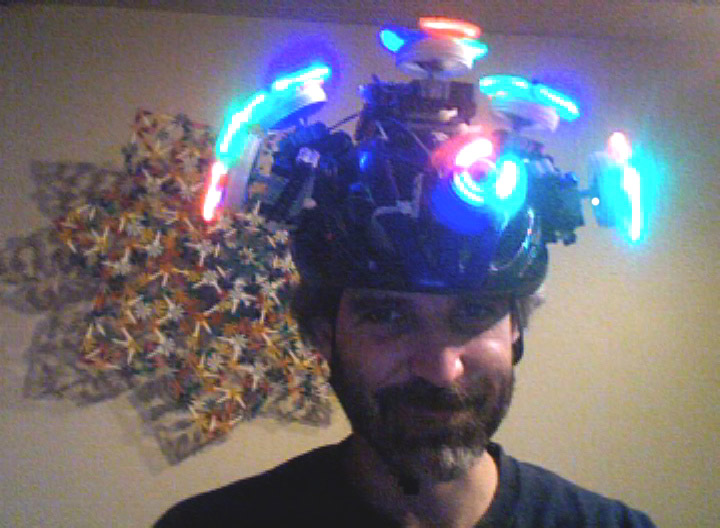
 Spinny Hat 3.0
Ethan's unique Spinny Hat has six separate motor-driven color wheels, each one with
three LED lights (red, green, and blue). Its six small motors are operated by a micro-
controller system, and they reverse directions periodically to make the appearance of
the Spinny Hat even more stunning. Ethan updates his Spinny Hat each year with new
features or functions. He had been looking to improve his LED lighting devices, when
he came across the INOVA MicroLights on our website. After he got the new lights, he
wrote to me again, and he was extremely happy. As it happens, INOVA's MicroLights
have a dim setting that reduces apparent brightness and also increases battery life by
rapidly pulsing the light. The pulsing is not perceptible when the light is stationary, but
when the light spins around rapidly the pulsing creates a fascinating strobe effect. The
clear bodies of the MicroLights spread the light over larger areas than did his previous
light sources, resulting in a beautiful new spinning flower appearance. Mounting of the
MicroLights was remarkably adaptable to his design, the battery life is longer, and the
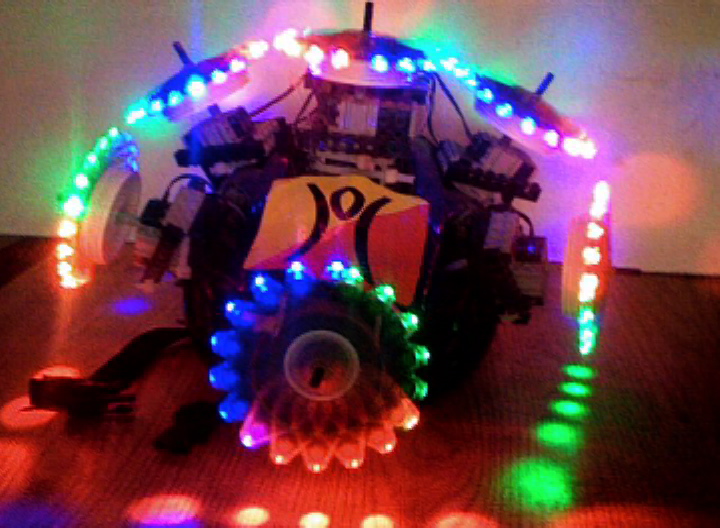
battery changes are now quick and easy. Spinny Hat 4.0 has arrived.
 Spinny Hat 4.0
Ethan made my day by sending me a video of the new and improved Spinny Hat. And
I must say that it is completely mind blowing! It was instantly apparent that this work of
art needed a home on the internet. With his permission, I have provided "Before" and
"After" pictures of his wonderful kinetic headgear (or Spinny Hat versions 3.0 and 4.0).
And below you will find links to his amazing twenty-second video. I have provided this
in three different file formats, so that you can use the video player applet of your choice.
But be forewarned - the video is extremely addictive, and works perfectly in loop mode.
If you would like to contact Ethan, search for his profile on LinkedIn.
SpinnyHat.mov - for QuickTime™ Player - 5,109.58KB (5,232,215 bytes)
SpinnyHat.rm - for RealPlayer™ - 5,460.38KB (5,591,424 bytes)
SpinnyHat.wmv - for Windows Media Player - 6,059.94KB (6,205,379 bytes)
Are you looking for our other articles regarding non-flashlight topics (such as
beverage
and sauce recipes, or video game add-ons and help-aids)? We have relocated
those
topics to a separate blog page for improved relevance across our website.
Click here
to visit our new This And That blog page, and take a
breather from the flashlight tech.
----(
Everything You Need To Know About Primary Battery Leakage )
----(
UV Currency Validation )----(
UV Inspection Applications )
----(
A Customer Project - Ethan Straffin's Spinny Hat Four Point Oh! )